
23rd October 2026
Cat pregnancy guide
Preparing your feline friend for a healthy pregnancy is vital, for the wellbeing of both her and her kittens. At this stage, it’s essential to do all the research you possibly can, while also preparing your cat’s home environment so she feels safe, calm, and comfortable.
Most insurance companies do not cover pregnancy or breeding-related problems. So, be prepared to cover all expenses and vet fees, in case something doesn’t go to plan and your feline friend and/or her kittens need emergency treatment.
You’ll have to book appointments for the kittens to be microchipped and vaccinated by a vet when they reach a certain age, too. Plus, you’ll need to administer vet-approved flea and worming treatment when the kittens are old enough.
In this guide:
- Signs your female cat is “in heat”
- How to tell if a cat is pregnant
- Is my cat pregnant or overweight?
- How a vet will check if your cat is pregnant
- Cat pregnancy timeline: week-by-week
- How to spot pregnancy in stray cats
- Potential problems during cat pregnancy
- Preparing for your cat’s labour
- Ways to prevent future feline pregnancies
- Cat pregnancy FAQs
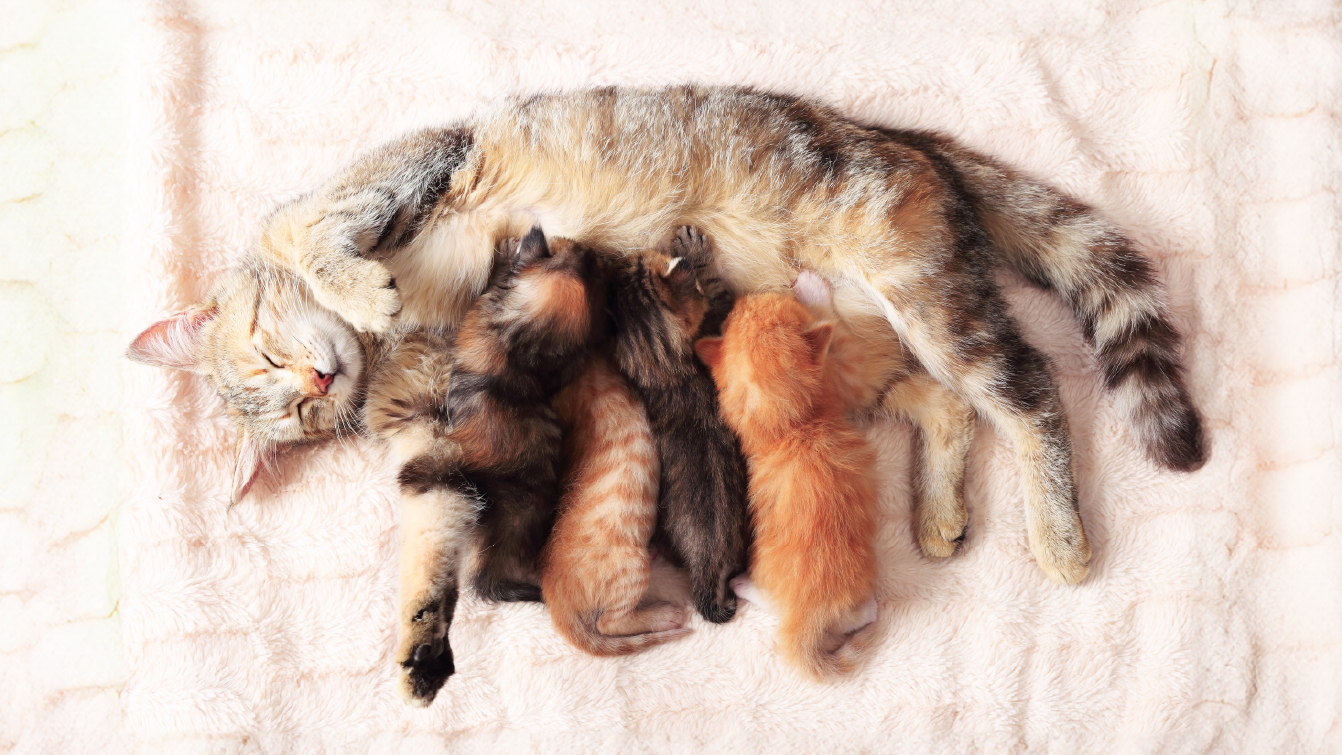
Signs your female cat is “in heat”
Before we can focus on the signs your cat may potentially be pregnant, it's important to be able to recognise the indicators that she's in heat.
“Heat” refers to the time in your female cat's cycle that she's at her most fertile. Cats who are in heat can get pregnant. Since cats as young as four months can have kittens of their own, it's something pet parents need to keep an eye on, in the interests of feline welfare!
Interesting fact: Did you know cats are capable of having kittens with multiple fathers in a single litter due to a process known as superfecundation?
From around February until October, your female cat could go through a cycle every few weeks. To protect her from pregnancy, your feline friend will need to be kept indoors, away from unneutered males, while she's at her most fertile.
Here are the signs your female feline could be in heat:
- Increased affection and clinginess
- Loud, frequent vocalising
- Restlessness and unsettled behaviour
- Rolling around on the floor
- Arching her back
- Holding her tail to one side
- Appearing uncomfortable or distressed
- Actively seeking the attention of male cats
For advice about taking care of your cat during her cycle, please speak to your vet.
How to tell if a cat is pregnant
If you suspect your cat might be pregnant, there are several cat pregnancy symptoms to look out for. You'll probably notice changes to her eating habits, sleeping patterns, nipples, body shape, and behaviour.
Eating habits
Unless they're feeling the effects of morning sickness (like humans can get!), your cat may be hungrier than usual if she's expecting. The further along in her pregnancy, the greater the likelihood that your cat's appetite will increase.
Sleeping habits
Creating life is tiring work! So, don't be surprised when your cat sleeps more than usual if she's pregnant.
Nipple changes
Your pregnant cat’s nipples are one of the key changes to look out for - and there are a few stages to their appearance.
A few weeks into pregnancy, your cat's nipples may swell and turn a pink colour – which is an indication of pregnancy. During the last week or so of pregnancy, you may notice your cat starts to produce milk.
The closer she gets to giving birth, the larger her nipples will become; she could also lose hair from around her nipples at this point.
Belly size
Alongside noticeable weight gain, your feline friend's body shape might transform so much that she has a dipped back and bulging abdomen.
Behaviour
Purring more than usual, and acting overly affectionate towards you, could suggest that your cat is pregnant. 'Nesting' is another common behaviour for pregnant cats. If she takes herself to a quiet, cosy spot and starts re-arranging blankets or bedding, it's likely she's nesting in preparation for the arrival of her kittens.
While these symptoms can definitely hint at potential pregnancy, the only way to confirm this is by taking your cat to the vet. They’ll be able to test, confirm the stage of pregnancy, and discuss the options available with you.
Is my cat pregnant or overweight?
While it can be challenging to know whether your cat is pregnant or just overweight, it's important to take note of how much you're feeding them. Over time, cats can pile on the pounds if they're eating too much food!
Sometimes, there are slight differences in appearance when a cat is overweight vs. when she's pregnant. For example, if your cat is overweight but not pregnant, you might notice:
- A round body shape
- Fat pads hanging under her belly
- Her ribs, backbone, and/or hip bones can't be felt
However, to accurately be able to tell the difference between obesity and pregnancy, you'll need the help of a vet. So, if you're unsure whether your cat is overweight or pregnant, it's best to take her to the vet to be checked over.
How a vet will check if your cat is pregnant
To confirm feline pregnancy, your vet may perform any of the following investigations:
- Physical examination
- An ultrasound scan
- A blood test
- X-rays (only recommended in certain scenarios)
The vet will probably ask you about any recent changes to your cat’s health, habits, and behaviour, too. At this point, it’s worth mentioning any signs you’ve noticed that could signify something isn’t quite right, e.g. unexplained nausea.
A vet will also be able to give you advice about:
- Providing your cat with the right nutrition, so she and her unborn kittens stay happy and healthy
- What types of exercise are safe for your cat while she’s pregnant
- The vaccinations, worming programmes, and flea treatments that are safe for pregnant cats
- How to support your cat while she’s giving birth, and what to do if something goes wrong
- Making sure your cat recovers well following the birth
- Taking care of newborn kittens
*The timing and type of worming treatment is particularly important for a pregnant queen. It’s recommended that your cat is treated with a suitable product approximately 7 days before they’re due to give birth.
Make sure to visit your vet for guidance and on purchasing the correct treatment. After birth, the new mother can be wormed with a kitten-friendly product at regular intervals to ensure her health and that of her kittens.
Cat pregnancy timeline: week-by-week
Cat gestation lasts for around nine weeks – that's approximately 63 to 65 days from conception to birth. Here's what to expect during each stage of the cat pregnancy period:
- Weeks 1-2: There’ll be no visible signs of feline pregnancy
- Week 3: Your cat won’t be in heat, and you may notice changes to her nipples
- Week 4: She may be feeling nauseated (morning sickness), which could cause your cat to seem off her food. You might also see changes to her weight
- Week 5: At this point, your vet should be able to tell you how many kittens your cat is carrying
- Week 6: Her kittens will be growing rapidly, so your feline friend is likely to have a very round tummy at this stage. To accompany her expanding waistline, your cat’s appetite will have increased by this time, too
- Week 7: Nesting behaviour begins this week; you might want to set up a cosy space for your cat, where she can feel safe and comfortable. She could be extra cuddly this week as well
- Week 8: The closer she gets to giving birth, the larger your cat’s nipples will become; she could also lose hair from around her nipples at this point
- Week 9: With the impending arrival of her kittens, your mum-to-be will probably display lots of anxious behaviour (e.g. pacing). This is typical pregnant cat behaviour before birth, so don’t worry
How to spot pregnancy in stray cats
Unless you're familiar with a stray cat and see her on a daily basis, it's tricky to tell whether or not she's pregnant from a distance.
Something worth noting, however, is that stray cats are often underweight if they aren't getting the right nutrition. So, if you notice a female stray cat whose ribs, spine, and/or hip bones are visible with a bulging abdomen, there may be a chance that she's expecting kittens.
Please contact your vet or local animal rescue centre for advice if you suspect a stray cat might be pregnant.
Potential problems during cat pregnancy
Keep an eye out for the following signs that something’s wrong, and call your vet immediately if you notice your pregnant cat is:
- Vomiting a lot
- Losing weight
- Refusing to eat
- Peeing more often
- Increasingly thirsty
- Producing discharge
Preparing for your cat’s labour
As your cat enters the final weeks of pregnancy, it’s a good idea to get everything ready for a smooth and stress-free delivery. Creating a calm, comfortable environment will help her feel safe when the big moment arrives.
Setting up a nesting area
Cats prefer a quiet, private, and calm spot to give birth to their kittens. If you don’t set up a suitable area, she may choose somewhere inconvenient – like the back of your wardrobe or under your bed!
The ideal nesting area should be:
- A large, sturdy box or basket lined with soft, washable bedding (ensure there are no loose threads)
- Placed in a quiet corner of your home where she won’t be disturbed
- Be free from draughts, as newborn kittens can’t regulate their body temperature
- Somewhere you can check on her discreetly without making her feel watched
You can introduce the nesting area a week or two before her due date so she has time to get used to it.
Top tip: Why not build a den to make your cat feel extra safe? Create a covered area that they can hide in by using a chair with a blanket draped over it, and make a cosy bed underneath. Also, make sure their food, water, and litter tray isn't too far away.
Signs your cat is close to labour
In the day leading up to labour, you may see some subtle behavioural changes, such as:
- A sudden drop in appetite
- Restlessness or pacing around her chosen nesting spot
- Scratching, pawing, or circling the bedding
- Seeking reassurance from you, or, in some cases, hiding away and wanting more privacy
What to expect during birth
Most cats give birth without any help and prefer that their humans stay nearby but not too close. Your role is mainly to observe quietly.
Once active labour begins, each kitten typically arrives within five to 30 minutes of straining. Kittens are born inside a membrane, which the mother will tear and clean away. She’ll also chew through the umbilical cord and eat the placenta – it’s completely natural and normal, don’t fret!
Many cats deliver their whole litter within about six hours. However, it’s not unusual for her to pause between kittens, sometimes for many hours, especially if she feels stressed or unsafe. If she is resting comfortably and not straining, this can be normal.
When to call your vet during labour
While complications are uncommon, contact your vet immediately if:
- Your cat has been pushing for over 20 minutes with no sign of a kitten being born
- A kitten can be seen but hasn’t been delivered after 10 minutes
- There is excessive bleeding or a foul-smelling discharge
- Your cat appears very tired, in pain, or unwell
- Labour has paused for several hours and you suspect there are still kittens inside
Ways to prevent future feline pregnancies
Whether or not your cat has already had a litter of kittens, it’s important to understand the ways to prevent future pregnancies in order to keep her safe.
As you can see, pregnancy, birth, and nurturing a litter of kittens can be stressful for cats, as well as posing risks to their health and wellbeing. Instead of putting your feline friend (and yourself!) through the worries of managing a litter of kittens, we recommend making the most of spending quality time with her.
Here are a couple of ways to prevent feline pregnancies, along with an alternative option to breeding from your cat:
Get your female cat spayed
The only guaranteed way to prevent your cat from becoming pregnant is to get her spayed (neutered). Visit our article all about the procedure for spaying cats to find out more.
Spaying your cat offers other health benefits, too – like reducing the risk of pyometra (a life-threatening infection of the womb) and lowering the risk of certain cancers (e.g. breast cancer).
In fact, research has shown that cats who are spayed before six months of age are up to 91% less likely to develop mammary cancer compared to cats that are not spayed.
Keep her away from unneutered male cats while she’s in heat
As we mentioned earlier, keeping your cat safely indoors when she’s in heat will stop unneutered males from going anywhere near her!
It’s worth noting that cats can go into heat shortly after giving birth, and some may even become pregnant within 2 weeks, even while they’re still nursing another litter. To prevent this, consider isolating her if she comes into season again, and consult your vet about spaying her sooner rather than later.
Consider adopting a kitten instead of breeding from your cat
The ongoing rehoming crisis, due to the rising cost of living, has meant there are thousands of cats in rescue centres waiting for forever homes.
Yet, despite rescue centres bursting at the seams with abandoned pets, many owners don’t have their cats neutered before letting them roam – which leads to unwanted kittens being born.
Alternatively, the soaring cost of living might cause some owners to believe that breeding from their pet is a viable option for extra income.
Unless you’re an experienced breeder with the right knowledge, space, and financial capability to properly care for your cat and her kittens, please think twice before breeding from her. If you’d like a lovely little kitten to join your family, there are countless cute kittens awaiting new homes in rescue centres across the country!
Do you need some help finding a local rescue centre? Get in touch via Facebook or Instagram, and we’d be happy to connect you with one of the charities we support.
Final tips
Pregnancy can be unpredictable, and even healthy cats may need unexpected veterinary care.
While most cat insurance policies don’t cover routine pregnancy or breeding costs, having cover in place can help to protect your cat once her kittens are born, and in case unrelated illnesses or accidents occur along the way.
Cat pregnancy FAQs
Female cats are capable of becoming pregnant surprisingly young; sometimes as early as four months, though most reach fertility around five to six months of age. For this reason, it’s crucial to have your cat spayed promptly or keep her indoors and away from unneutered males until the procedure is done.
Pregnant cats require extra calories to nourish their developing kittens. By the end of the first month of pregnancy, transition her to a high-quality kitten food or a formula designed for expectant and nursing mothers.
As her abdomen expands, her stomach capacity will shrink, so she may do better with smaller, more frequent meals. Keep her on this enriched diet until all of the kittens have finished weaning and be sure to consult your vet for the avoidance of any doubt.
While it can be challenging to know whether your cat is pregnant or just overweight, it's important to take note of how much you're feeding them. Over time, cats can pile on the pounds if they're eating too much food!
Sometimes, there are slight differences in appearance when a cat is overweight vs. when she's pregnant. An overweight cat often shows signs including:
- A round body shape
- Fat pads hanging under her belly
- Her ribs, backbone, and/or hip bones can't be felt
However, if you’re ever in doubt, your vet will be able to accurately confirm whether or not there’s a pregnancy.
The average litter size is four kittens, but cats can have anywhere between one to twelve kittens in a single litter.
Most queens give birth to all their kittens within roughly six hours. During active pushing, each kitten typically appears anywhere from about five to thirty minutes apart.
However, if she becomes stressed or feels unsafe, your cat may temporarily halt labor for a long period of time (such as 24 to 36 hours) before continuing with the remaining deliveries.
Related articles:

Looking for more cat advice?
We’ve written some handy cat advice guides, to help you unlock the secrets of your mysterious moggy.
Need cat insurance?
Cat insurance can help cover the cost of veterinary treatment if your cat gets injured or falls ill.
We know pets
Here at Animal Friends Insurance, we're multi-award winning, with a passion to create a better life for every animal.
Since we were founded over 25 years ago, we protect the nation’s pets, while also making a difference to animal welfare and our planet. Thanks to you, we've donated over £10 million to more than 830 animal welfare charities and conservancies, helping to support vulnerable pets and wildlife around the world.
We’re proud to offer pet insurance that helps make a difference to the lives of animals everywhere.
The charitable work undertaken by Animal Friends Insurance is not regulated by the Financial Conduct Authority.