

What colours can dogs see?
Your dog’s vision explained
2nd February 2026
Are our dogs colour blind? Can canines only see in black and white? Do hounds have excellent vision? We have a lot of questions!
Since there are so many myths out there, at some point, most pet parents may wonder how their canine companions really see the world. In this blog, we share some insights surrounding our dogs’ vision and how we can help them feel more comfortable in our homes.
Are dogs colour blind?
Many pet parents wonder if their dogs can see colour or not. The truth is, dogs don’t see in black and white, their world just looks more muted than ours.
They can’t distinguish reds and greens, but they do see a variety of yellows, blues, and greys. Some experts point out that dogs’ colour vision is similar to people with red-green colour blindness.
It’s worth pointing out that just like in human babies, puppies can’t see colour immediately after birth. When dogs are very young, they can only make out shapes in black, white, and grey. Most dogs start to see shapes and colours more clearly when they’re around 8 weeks old, and develop their adult eyesight at six months old.
How many colours do dogs see?
Dogs can see two main colours: blue and yellow. This is because dogs have fewer cone photoreceptors in their retinas than humans do.
While human eyes have three cones that can identify colour combinations of red, blue, and green, dogs have dichromatic colour vision, meaning they possess only two types of cones and can only really see blue and yellow.
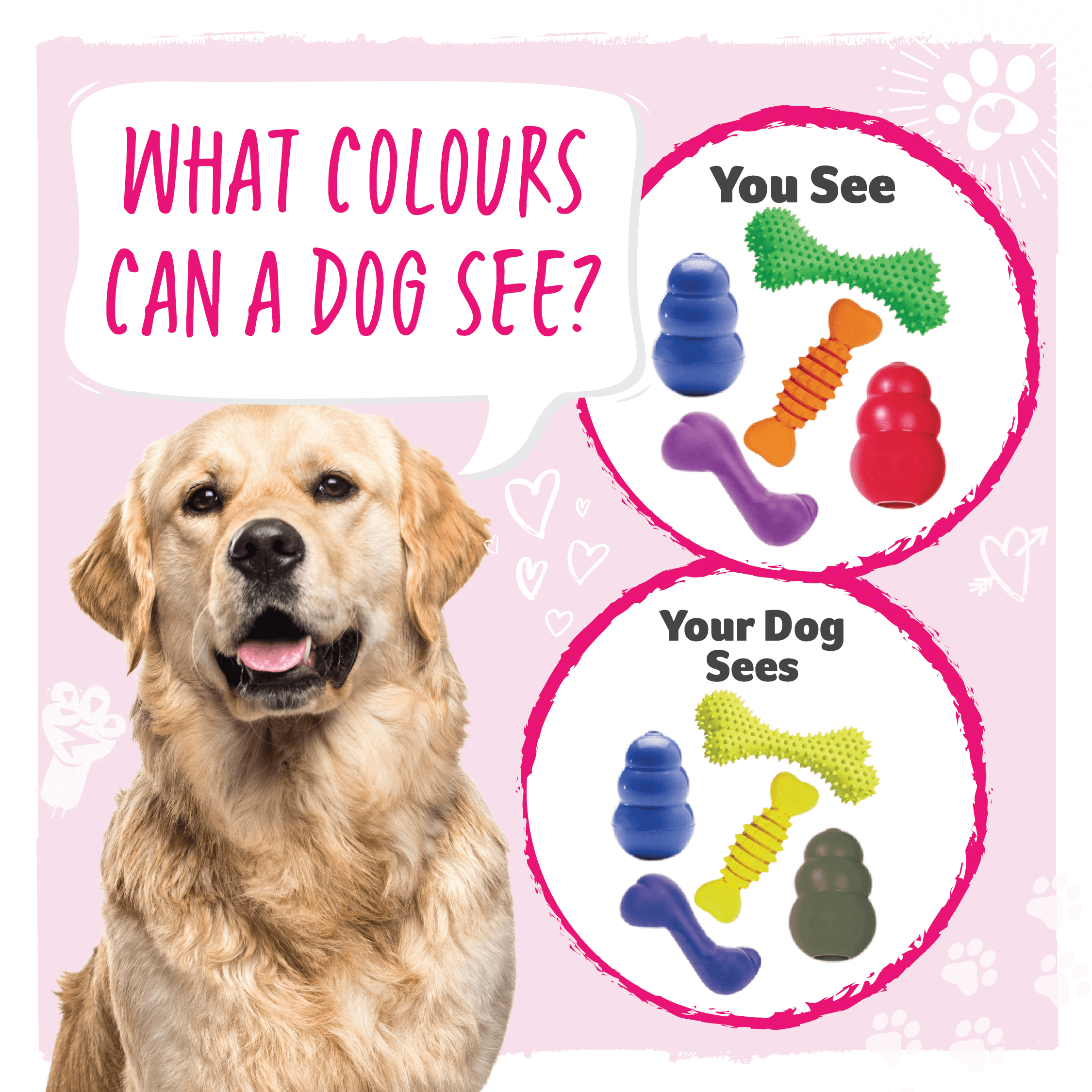
Research shows that when playing fetch or training, dogs are more likely to spot blue and yellow toys than red or orange ones - which can appear as shades of brown, yellow, or grey.
This illustration helps to show what colours dogs can see:
How else does a dog's eyesight differ from ours?
Our dogs’ super-cute ‘puppy eyes’ are capable of far more than melting human hearts! What their eyes lack in colour vision, they more than make up for in other ways, including:
- Better motion perception: Dogs have more rod cells in their eyes, allowing them to detect the slightest movement - even in low light.
- Better night vision: A special reflective layer behind the retina, called the tapetum lucidum, helps them see up to six times better than humans in dim conditions.
- Broader field of view: Dogs have wider-set eyes which gives them a larger field of view. This is advantageous from an evolutionary hunting perspective, but they have less depth perception than people.
Interestingly, there’s even some limited evidence that dogs might be able to perceive ultraviolet light too, though experts aren’t yet sure how this ability might affect their behaviour or navigation.
Fun fact: Over the centuries, dogs have evolved their eye shape to allow them to communicate better with humans!
How to decorate your home in a dog-friendly style
We’re so fortunate to be able to share our lives, and our homes, with our dogs. However, some decorating decisions can impact how safe and comfortable they feel because of the different ways dogs see colours and contrasts. Don’t worry though - we’re here to help! Discover our top tips for pet-friendly decorating:
Colours
Some of the colour combinations we use while decorating our homes can create a less-than-relaxing environment for our furry best friends, but here are the best dog-friendly colours to use in your home.
What colours do dogs like vs. dislike?
For a canine-friendly colour scheme, look to incorporate bursts of bright blues and yellows throughout your home. Especially consider this when choosing dog-specific accessories, such as their food bowl and toys, so they can easily see, appreciate and engage with these objects.
The one colour we suggest avoiding in your home if decorating with your pooch in mind is red. Because dogs’ colour vision is very different to ours, reds may appear as a dull dark brownish-grey or even black - and won’t add the vivid ‘pop of colour’ to your home that you hope for.
It’s also good to keep in mind the colours which are indistinguishable to your dog - shades of orange and green will all look like varying shades of yellow, while purple and violets become hues of blue.
While dogs are unable to distinguish certain colours from one another, it is believed that their vision is more attuned to contrasts.
A monochromatic colour scheme may be pleasing to the human eye but buying all your furniture, soft furnishings and accessories in one shade may make it harder for your dog to discern objects from one another.
Instead, play with pairing sharp contrasting colours together. To keep this visually appealing for yourself, as well as your dog, decorate with colours on opposite sides of the colour wheel to maintain balance.
Canine-friendly Christmas colours
Those who celebrate wintertime festivities are more than likely to decorate their homes with a host of Christmassy colours – most of which aren’t featured for the rest of the year. During the festive season, however, decorating our homes might have an impact on our pets.
To avoid upsetting your pooch with bright red decorations, here's how to create a beautiful yet pet-friendly festive display:
For a canine-friendly Christmas colour scheme, look to incorporate bursts of bright blues and yellows throughout your home. To keep things feeling festive, weave in rich navy and gold accents to give your home a modern and sophisticated winter wonderland theme!
Clutter
Canines tend to have 20/75 vision (humans without glasses usually have 20/20 vision; they can see 20 feet out of 20 feet clearly), meaning objects become blurry at a distance. So, if your home is very cluttered, your furry best friend may find it difficult to navigate their way around the house.
For your pooch, a cluttered home can be a dangerous one - making it harder for them to navigate through and increasing their likelihood of slips and trips.
Find out how to keep clutter from confusing your canine companion, by checking out our five easy steps to pet-proof your home!
Lighting
Cats might get all the credit for being able to see in the dark, but your pooch’s night vision is pretty good, too!
Thanks to the way light is reflected into their eyes, your dog’s vision is excellent in dim light. However, here’s what top designer, Marlena Kaminska of ValueLights, has to say about your pet’s preferred lighting situation:
While dogs can see better in dim lighting than humans, they will still struggle to see in pitch-black conditions. If you leave your dog downstairs at nighttime, it may be a good idea to leave a table lamp on for their comfort.
Dogs have also been found to be more sensitive to the type of flicker produced by LED lights than humans. Avoid twinkling LED lights in any rooms your pet frequents - especially spaces they like to sleep in.
Textures
Your dog’s perspective on texture may not be something you considered while decorating your home. Here's how to provide the ulti-mutt canine-friendly experience throughout your home:
Outside of the world of colour, your decor can be made much more interesting to your pup through what they can feel. Incorporating various textures throughout your home can enhance how they experience the space.
Rugs, cushions and blankets are easy to incorporate no matter your existing decor - and are likely to be a big hit with your dog. Why not channel a Christmas in the Scottish Highlands, and deck your home with thick, plush blankets and felt tartan accessories?
From a practical point of view, picking a dark or patterned fabric is more pet-friendly, as this will better disguise any paw prints, scratch marks or pet hair.
Conclusion
From understanding how dogs’ colour vision works to tips for creating a safe and stimulating space for your dog at home - we hope you’ve learnt more about how your pooch sees and experiences the world.
Get more canine companion care tips on our Dog Blog or Dog Advice hubs, or browse related articles below.
Related resources

Need dog insurance?
Dog insurance can help cover the cost of veterinary treatment if your dog gets injured or falls ill.
We know pets
Here at Animal Friends Insurance, we're multi-award winning, with a passion to create a better life for every animal.
Since we were founded over 25 years ago, we protect the nation’s pets, while also making a difference to animal welfare and our planet. Thanks to you, we've donated over £10 million to more than 830 animal welfare charities and conservancies, helping to support vulnerable pets and wildlife around the world.
We’re proud to offer pet insurance that helps make a difference to the lives of animals everywhere.
The charitable work undertaken by Animal Friends Insurance is not regulated by the Financial Conduct Authority.
More on our dog blog
Read more news articles, opinion pieces, reviews and personal stories behind our dogs on our blog.