
20th May 2026
Staffordshire Bull Terrier breed guide
Staffordshire Bull Terriers or "Staffies" are affectionate, active, and fun-loving canine companions who adore being part of a family!
Read our guide to find out more about the lively Staffordshire Bull Terrier breed.
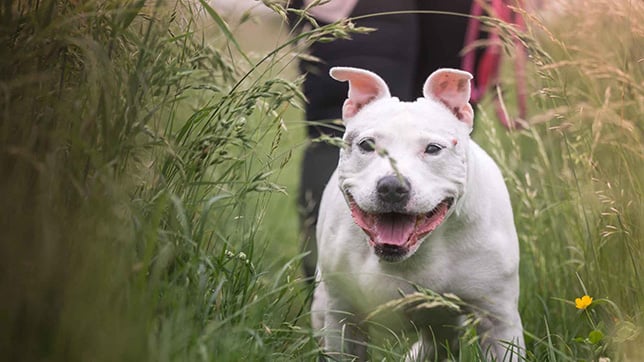
Please note: We’ll refer to dogs of the Staffordshire Bull Terrier breed as ‘Staffie’ or ‘Staffies’ throughout this breed guide.
Staffordshire Bull Terrier overview
| Size | Medium - 11-17kg |
| Lifespan | 12-14 years |
| Exercise needs | Medium - 1 or 2 hours daily |
| Grooming needs | Low - weekly grooming required |
| Suitable for | Families and households with other pets. Needs training and socialisation. |
| Outdoor space | Needs a garden to release it's energy |
| Common health issues | Skin issues, hip issues |
| Personality | Strong, energetic, affectionate |
Common characteristics of the Staffordshire Bull Terrier breed
Please remember that the following characteristics are considered ‘average’ for Staffordshire Bull Terriers, and since each dog is a unique individual, your Staffie’s characteristics may differ.
How big are Staffordshire Bull Terriers?
Staffies tend to reach a height of 35-41cm (at the shoulder), with females sometimes measuring shorter than males.
How much do Staffordshire Bull Terriers weigh?
While males often weigh more than females, the average weight of a Staffie is around 11-17kg.
How long do Staffordshire Bull Terriers live?
In general, most Staffies have a lifespan of about 12-14 years.
Typical Staffordshire Bull Terrier appearance
Staffordshire Bull Terriers have a distinctive, broad head shape with a short muzzle and prominent cheeks that are ‘pawfect’ for creating those characteristic cheerful smiles!
They have bright, round eyes and small ears that are slightly folded at the ends, like rose petals. A Staffie’s body shape should be compact and muscular, with strong legs and medium-sized paws.
The Staffie also has a low set tail that tapers to a point and likes to wag continuously!
Their short, smooth coat needs weekly brushing to stay shiny and in tip top condition. Plus, Staffie coats can range in colour and have a variety of markings. So, Staffies can be seen in solid colours, like black or blue (pale grey), or more unusual patterns, like brindle (darker striped pattern over a lighter base colour).
Typical Staffordshire Bull Terrier temperament
These cheerful dogs adore being part of a family. So, your Staffie will likely want to be involved in every family adventure – from camping and beach trips to holidays and shopping. Having such a passion for people can sometimes lead Staffies to become over-excited and boisterous though, so you’ll probably need to train your Staffie not to jump up!
Additionally, Staffies may suffer from separation anxiety if left alone for too long.
Staffordshire Bull Terriers are extremely clever, which means they’re fantastic to train, especially if you find the right reward to motivate them! Although, because Staffies are such excitable dogs, they can be strong and pull on the lead. So, you might have to spend extra time working on your Staffie’s loose lead walking skills.
Thanks to their high energy levels mixed with their intelligence, Staffies need at least an hour of exercise every day, alongside plenty of mental stimulation when not out and about. If they don’t have enough opportunity to keep their minds occupied, Staffies are known to display undesirable behaviours, e.g. chewing furniture.
Staffordshire Bull Terrier health conditions
It’s not unusual for pedigree breeds to be prone to certain health concerns, and, unfortunately, Staffies are no exception. Here are a few health conditions commonly seen in the Staffordshire Bull Terrier:
- Skin allergies.
- Hip dysplasia.
- Cataracts.
For further information about some of the common conditions experienced by Staffies, please visit our Staffordshire Bull Terrier health problems article.
Remember: Keep an eye out for any health issues your Staffie may develop, and get your canine companion checked by a vet if you have any concerns. If you are considering pet insurance, be sure to read our guide about insuring your Staffordshire Bull Terrier.
Common questions about Staffordshire Bull Terriers
All dogs have certain traits or characteristics that make them so special, but somewhere along the way some misconceptions can arise leading to certain breeds being misunderstood.
With Staffordshire Bull Terriers spending, on average, more than 23 per cent longer in rescue centres, the loveable pooches are victims of decades of judgement.
Here are some myths about the breed debunked!
Staffies are known as a ‘nanny dog’ because of their temperament around children. While no child should be left unattended with any dog, given the right training and enough affection these dogs will show incredible loyalty and respect towards its family.
This can be true for any dog that’s not properly socialised from an early age. So, Staffies can live in multi-dog homes, share their bed with their kitty sibling, and play with the pooches they may meet on their daily walks. Just don’t forget the importance of training and socialisation.
Every dog is just as cute when they grow up as they were when they were puppies and their love for you will grow as they age.
Some Staffordshire Bull Terriers can be quite stocky animals and people might mistake them for other breeds, like a pit bull. Pit bulls fall under the Dangerous Dogs Act whereas a Staffie doesn’t, so they’re not a banned breed.
Staffordshire Bull Terriers took the top spot in ITV’s Britain’s Favourite Dogs, which hopefully has helped dispel some myths about these beautiful pooches.
Staffordshire Bull Terrier breed history
It’s believed that the Staffordshire Bull Terrier breed was developed in the 1860s in the Black Country of Staffordshire and northern Birmingham, through crossing bulldogs with terriers.
Initially, the purpose of crossing bulldogs and terriers was to develop a dog who could hunt vermin effectively, yet Staffordshire Bull Terriers sadly proved popular for dog fighting as well.
Although Staffies were owned by all social classes during the Victorian era, they were often part of working-class families and lived in cramped conditions alongside large groups of people. However, it was during this time that owners started to realise how gentle Staffies were with children, which is why they increased in popularity with families.
Despite their long history, the Kennel Club didn’t recognise the Staffordshire Bull Terrier as pedigree dog breed until the 1930s.
Fun facts about Staffordshire Bull Terriers
- Unlike other breeds, the Staffordshire Bull Terrier must wear a broad leather collar with a brass emblem of a Staffordshire knot while competing in the show ring.
- Staffies are sometimes referred to as ‘nanny dogs’ due to their natural tendency to get along well with children.
- In 2018, Staffordshire Police adopted a Staffie named Cooper to train as their first Staffordshire Bull Terrier police dog.
- Many celebrities are fans of the Staffordshire Bull Terrier breed and are known to have owned Staffies, including Jessica Alba, Kevin Bacon, and Liam Hemsworth!
- Studies prove that Staffies do not show an increased risk of aggression compared with other dog breeds, meaning their history as fighting dogs doesn’t seem to influence their temperament.

Need insurance for your Staffordshire Bull Terrier?
Dog insurance can help cover the cost of veterinary treatment if your Staffordshire Bull Terrier gets injured or falls ill.
Looking for more dog advice?
Find the information you need as we support you through every step of your journey with your canine companion.
We know pets
Here at Animal Friends Insurance, we're multi-award winning, with a passion to create a better life for every animal.
Since we were founded over 25 years ago, we protect the nation’s pets, while also making a difference to animal welfare and our planet. Thanks to you, we've donated over £10 million to more than 830 animal welfare charities and conservancies, helping to support vulnerable pets and wildlife around the world.
We’re proud to offer pet insurance that helps make a difference to the lives of animals everywhere.
The charitable work undertaken by Animal Friends Insurance is not regulated by the Financial Conduct Authority.