Understanding eye conditions in cats
In this article, we’ll guide you through the key symptoms to look out for, plus the most common eye conditions in cats — including those that become more likely in later life.
1st September 2026
Have you ever gazed lovingly into the eyes of your moggy and been mesmerised by their loveliness? This can come in particularly handy when it comes to keeping on top of your cat’s health.
Cats of all ages can experience eye problems, from minor irritations to more serious conditions. But as your cat enters their senior years, changes inside the eye become more likely, and spotting them early can make a real difference to their comfort and long-term vision.
In this guide:
- Signs of eye problems in cats
- Common eye conditions in cats
- Eye conditions more common in senior cats
- Are certain breeds more susceptible to eye conditions?
- When to see a vet
Signs of eye problems in cats
We’ve put together a list of the most common symptoms of eye problems in cats, so you can know what’s going on with your feline friend’s peepers.
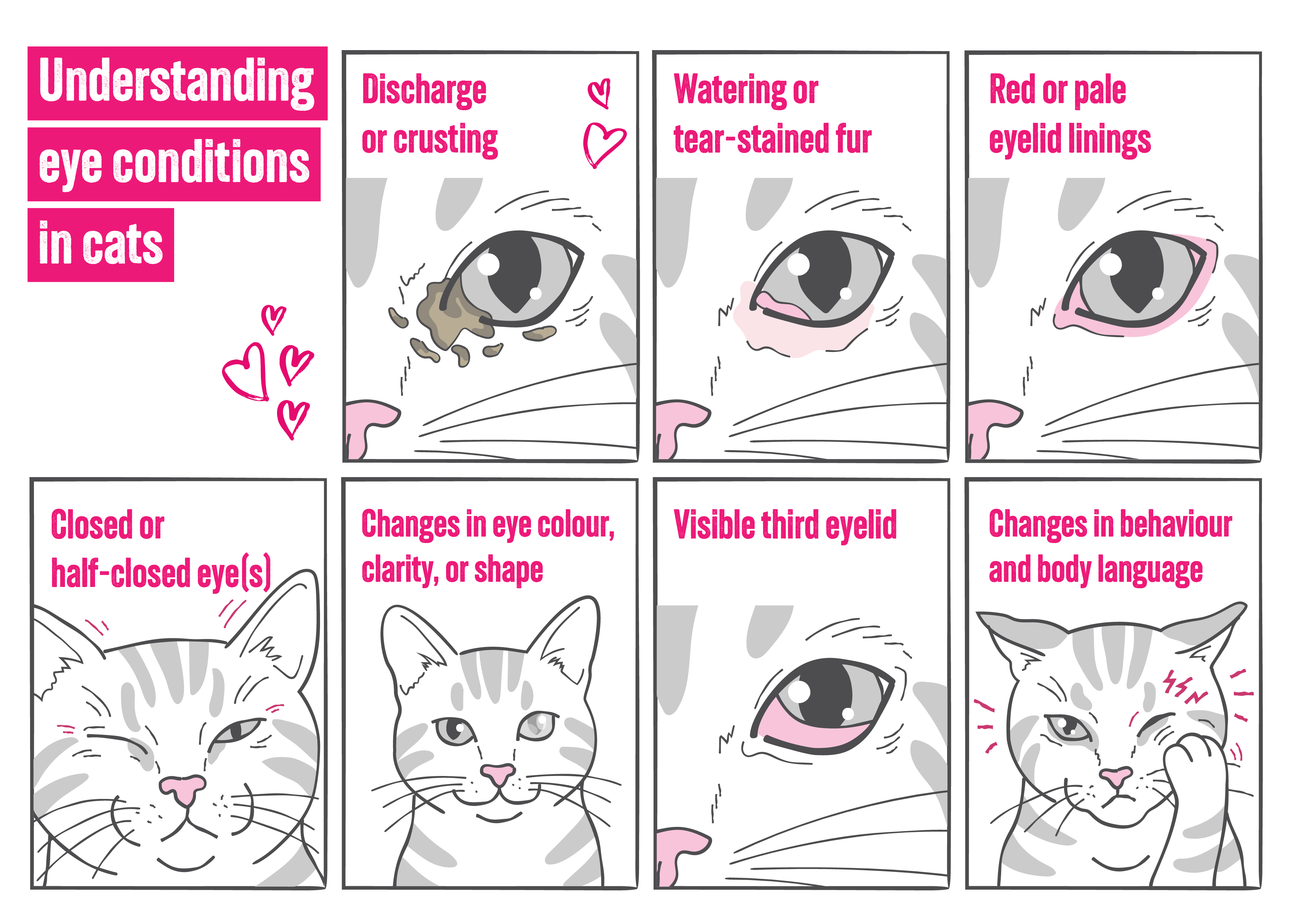
Discharge or crusting
Eye discharge can be thick and sticky or more thin and watery. It may look milky, yellow-green, or clear with tear-staining. When it dries, it can form a crust around your cat’s eyes that can sometimes irritate the skin or scratch the cornea.
You can gently clean away any mild discharge using cotton gauze soaked in warm water, wiping from the inner corner outward. Use a fresh piece for each eye. Avoid cotton wool, which can leave fibres behind.
A little occasional discharge is usually nothing to worry about, but if it’s a regular or persistent problem it could mean your cat has conjunctivitis, irritation, allergies, or other infections.
Watering or tear-stained fur
Cats can sometimes get weepy or watery eyes. If your cat’s eyes seem wetter than usual, if they’re blinking a lot, or if there are often tear tracks on the fur around their eyes, it could be a sign of irritation, inflammation, or blocked or partially occluded tear ducts.
Red or pale eyelid linings
It can help to be familiar with what your cat’s eyes normally look like, including the colour of the eyelid lining. If you ever notice that this lining looks much redder or paler than usual, it’s worth speaking to your vet and booking an appointment to find the cause.
Closed or half-closed eye(s)
This is a fairly clear sign that something is going on. If you notice that your cat is either shutting (or half-shutting) one or both eyes, or if they are “glued” shut by crusty gunk then there is likely to be an underlying cause that needs investigating by your vet.
Changes in eye colour, clarity, or shape
Eye colour can change for a number of reasons, gradually or over time. If you spot a sudden change, or if the eye starts to go cloudy, that could mean a number of things. If your cat’s eye starts to change size or shape, or looks like it’s bulging, this could be a sign of glaucoma or other eye conditions.
If any of these symptoms appear you should speak to your vet as soon as possible. Some conditions, such as glaucoma, can worsen quickly without treatment.
Visible third eyelid
Cats have a third eyelid under the external one we can see. This eyelid is white and translucent and helps clear the eye of debris, as well as distributing tear fluid evenly over the eye. This is sometimes visible in the evenings when your cat is tired but it’s worth noting when you can see it during the daytime or if it starts to look inflamed.
Changes in behaviour and body language
There are more general behaviours that your cat might exhibit if there’s something wrong with their eyes.
If they’re rubbing their eyes against furniture or bedding, or pawing and scratching at their eyes, this could be a sign of an infection or irritation. They may also be more lethargic, irritable, or avoid bright lights.
Common eye conditions in cats
Conjunctivitis
One of the most common eye problems in cats is conjunctivitis, or inflammation of the inner eyelid (conjunctiva). According to a recent clinical study of 107 cats with eye disease, conjunctivitis made up just over 40% of all cases, showing just how common the condition is.
Cats with conjunctivitis often develop red, swollen eyelids and watery, sticky, or mucous-like discharge. Viral infections, especially feline herpesvirus (FHV-1), were noted in the study as the most common underlying triggers, although allergies, bacteria, and minor trauma can also set it off.
While some cases resolve quickly, untreated conjunctivitis can become painful and may even lead to scarring, so it’s always worth speaking to your vet if your cat’s eyes look sore or the discharge persists.
Corneal ulcers
A corneal ulcer develops when the clear surface of the eye becomes damaged. In the same 2025 study, ulcers were identified in 7.54% of feline cases and were most often linked to scratches, foreign bodies, or ongoing viral infection. Cats with entropion (where the eyelid turns inwards) were also more likely to develop ulcers, as the lashes or fur repeatedly rubbed against the cornea.
Ulcers are painful, so cats may squint continuously, keep the eye closed, or produce a cloudy film or discharge. Because these wounds can deepen fairly quickly, prompt veterinary treatment is essential to avoid long-term damage to the cornea.
Eyelid and eyelash disorders
Several eyelid and eyelash problems can affect cats throughout their lives. In a recent clinical review, conditions such as blepharitis (inflammation of the eyelid), trichiasis (fur rubbing on the cornea), and entropion were all documented, with blepharitis appearing in over 12% of cases.
Some conditions are present from birth, while others develop later due to irritation, chronic inflammation, or trauma. Any persistent rubbing, swelling, or crusting around the eyelids should be assessed, as these conditions can cause significant discomfort and increase the risk of corneal injury.
Corneal sequestrum
Corneal sequestrum is a condition unique to cats, where a dark, leathery patch forms on the cornea. Chronic inflammation — particularly from FHV-1 infection or conditions like entropion — is thought to play a role in its development.
Cats with a sequestrum usually show sensitivity to light, persistent tearing, and visible discomfort. Because the damaged tissue often needs specialist management or surgical removal, this is a condition that’s best caught early.
Eye conditions more common in senior cats
While eye trouble can be a symptom of a completely different problem (like respiratory illness) or even of a dietary deficiency, there are some illnesses, conditions, and afflictions that could directly affect their eyes, particularly into their old age.
Lenticular sclerosis (normal age-related change)
Lenticular sclerosis, also known as nuclear sclerosis, is one of the most common age-related changes seen in older cats. It appears as a soft, bluish haze within the lens and happens because the lens naturally becomes denser over time.
Importantly, this isn’t a disease and it usually doesn’t impact a cat’s vision. In fact, in the 2017 study of ageing cats, lenticular sclerosis was found in over 80% of cases, showing just how common this eye change is.
Because lenticular sclerosis can look similar to early cataracts, many owners understandably worry when they spot cloudiness. A quick vet check can help distinguish between the two.
Cataracts
Cataracts occur when part of the lens becomes abnormally cloudy, rather than uniformly hazy as with lenticular sclerosis. This cloudiness can worsen slowly over months or years, but in some cats — especially those with diabetes, previous inflammation, or genetic predispositions — the change can progress more quickly.
Cats with cataracts may appear hesitant in dim light or may misjudge distances. Some cataracts remain small and stable, but if they interfere with daily life, surgery may be recommended.
Any sudden cloudiness, dark patches within the lens or changes in how your cat navigates their environment should prompt a call to your vet.
Glaucoma
Glaucoma develops when fluid inside the eye can’t drain as it should, causing pressure to build. This pressure damages the optic nerve and, without prompt treatment, can lead to irreversible sight loss. In the ageing-cat study, glaucoma was a major contributor to impaired vision.
A cat with glaucoma may develop a noticeably enlarged or bulging eye, cloudiness, a persistently dilated pupil, or sudden vision loss. Many become quiet, hide more often or rub at the eye because of discomfort.
Older cats, especially those with pre-existing conditions such as uveitis or lens dislocation, are at higher risk. Because glaucoma can progress quickly, rapid veterinary attention is very important.
Hypertensive eye disease
High blood pressure becomes more common in older cats, especially those with kidney or thyroid disease, and it can have a sudden, dramatic impact on vision. The 2017 study found that hypertension was a major cause of retinal damage and sudden blindness in senior cats.
Cats may show dilated pupils, sudden disorientation, or a rapid loss of vision. Because retinal detachment can happen quickly, these signs should be treated as an emergency. Regular blood pressure checks are an essential part of senior cat care.
Uveitis
Uveitis is painful inflammation inside the eye and can develop for several reasons, including infection, injury, or high blood pressure. In the 2017 study, many cats with glaucoma also had underlying uveitis, showing how closely the two conditions are connected.
Affected cats may show redness, cloudiness, squinting, or unusually small pupils. Because uveitis can threaten long-term vision if left untreated, early veterinary care is important.
Are certain breeds more susceptible to eye conditions?
Some cat breeds are simply more likely to experience particular eye issues than others. For instance, Persians, Himalayans, and Burmese cats can be predisposed to conditions such as entropion, eyelid agenesis, and corneal sequestrum, largely because of the way their eyes and eyelids naturally develop.
Flatter-faced breeds may also pick up irritation or corneal scratches a little more easily, as their eyes are more exposed.
That said, many eye problems seen in senior cats — including glaucoma, retinal detachment, and age-related lens changes — can affect any cat as they grow older.
So, while some cat breeds deserve a little extra monitoring, regular eye checks and prompt vet care are important for all ageing cats, whatever their pedigree.
When to see a vet
Some eye conditions are easier to spot than others, and may take time to develop. However, there are some signs that need veterinary intervention straight away, including:
- Persistent or worsening discharge
- A closed or bulging eye
- Visible third eyelid for more than a few hours
- Sudden cloudiness or colour change
- Blood in the eye
- Unequal or fixed pupils
- Sudden bumping into objects or disorientation
- Severe redness or swelling
Eye conditions in cats can worsen rapidly, so early diagnosis and treatment gives you the best chance of protecting their sight.
Conclusion
While many symptoms of eye problems in cats turn out to be minor, it’s always sensible to speak to your vet if something doesn’t look right.
Insuring your cat gives you peace of mind that you and your pet will be covered if anything unexpected were to happen. Animal Friends offer a variety of policies for dogs, cats, and horses, and we also insure older pets.
Please note that this article is not intended as a medical document. If you are in any doubt please consult a veterinarian.
Related resources:
Read our cat blog!
If you found this article useful, why not visit our cat blog for more news, insight and opinion pieces?
Need cat insurance?
Cat insurance can help cover the cost of veterinary treatment if your cat gets injured or falls ill.
We know pets
Here at Animal Friends Insurance, we're multi-award winning, with a passion to create a better life for every animal.
Since we were founded over 25 years ago, we protect the nation’s pets, while also making a difference to animal welfare and our planet. Thanks to you, we've donated over £10 million to more than 830 animal welfare charities and conservancies, helping to support vulnerable pets and wildlife around the world.
We’re proud to offer pet insurance that helps make a difference to the lives of animals everywhere.
The charitable work undertaken by Animal Friends Insurance is not regulated by the Financial Conduct Authority.