
26th May 2026
Yorkshire Terrier breed guide
Despite their small size, Yorkshire Terriers are sassy, self-assured, and pack a lot of personality into a tiny frame!
Read our guide to find out more about the faithful Yorkshire Terrier breed.
Yorkshire Terrier overview
| Size | Small - 1-3kg |
| Lifespan | 12-15 years |
| Exercise needs | Low - 1 hour daily |
| Grooming needs | High - daily grooming required |
| Suitable for | Families and households with other pets who can be attentive to this lively breed |
| Outdoor space | Needs a small garden and can live happily in a house or flat |
| Common health issues | Dental, Trachea |
| Personality | Lively, affectionate, companion |
Common characteristics of the Yorkshire Terrier breed
Please remember that the following characteristics are considered ‘average’ for Yorkshire Terriers, and since each dog is a unique individual, your Yorkshire Terrier’s characteristics may differ.
How big are Yorkshire Terriers?
Yorkshire Terriers typically reach a height of 18-20cm (at the shoulder).
How much do Yorkshire Terriers weigh?
The majority of Yorkshire Terriers weigh about 1-3kg.
How long do Yorkshire Terriers live?
In general, Yorkshire Terriers tend to live for around 12-15 years.
Typical Yorkshire Terrier appearance
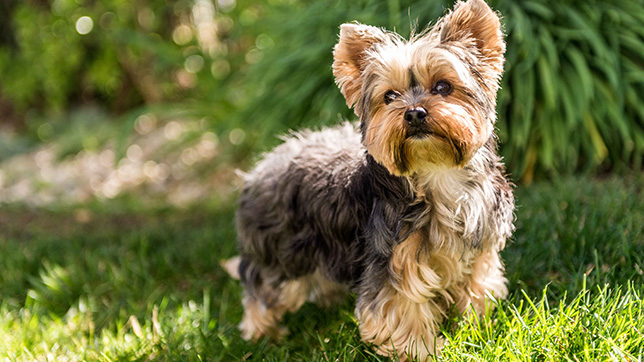
Part of the ‘toy’ group, the Yorkshire Terrier is a very small dog with short legs, a petite body, and feathery tail that’s sometimes carried upwards.
The Yorkshire Terrier’s characterful expression is made even more adorable thanks to their fluffy, teddy-like face, bright, round eyes, and triangular, pointy ears!
In terms of coat type, Yorkshire Terriers have long hair covering their entire body. Lots of Yorkshire Terriers need the hair around their face trimmed or tied up, to prevent it from irritating their eyes. Also, a Yorkshire Terrier’s coat can become tangled or matted easily, so they’ll require daily grooming to keep their coat silky and skin healthy.
Although Yorkshire Terriers tend to have a paler face, chest, undercarriage, and legs with darker hair along their back and hindquarters, there is some variation in coat colour, which can include:
- Black and tan (pale brown).
- Black blue (a black-grey hair mix) and tan.
- Blue (pale grey) and tan.
- Steel blue (dark grey) and tan.
- Steel blue, black, and tan.
- Steel grey (dark grey-white hair mix) and tan.
Typical Yorkshire Terrier temperament
Yorkshire Terriers are fiercely loyal, which can lead to the formation of a strong bond with their pet parent! Though the love they have for their pet parent can cause some Yorkshire Terriers to suffer from separation anxiety when left alone.
Socialising your Yorkshire Terrier is important, since they usually adore being centre of attention and won’t want to share your affection – which can mean some Yorkshire Terriers end up disliking other pets. So, it’s vital that any other dogs or cats are introduced safely to your Yorkshire Terrier when they’re young, to make sure they get along with each other.
While they may be in the ‘toy’ group, Yorkshire Terriers are terriers at heart – making them clever yet inquisitive. For lots of Yorkshire Terriers, their natural curiosity can get the better of them while out and about on adventures, which leads to them becoming distracted. To lessen the chances of having your Yorkshire Terrier ignore you during walkies, you’ll need to find the right reward and work on developing a strong recall during training!
Having such little legs doesn’t impact a Yorkshire Terrier’s ability to enjoy walks – in fact, they need at least 30 minutes of exercise every day to stay happy and healthy. And don’t be surprised if your Yorkshire Terrier wants to join you on all your adventures, like exploring new places or pet-friendly picnics.
Due to their intelligence, Yorkshire Terriers benefit from being offered plenty of mental stimulation to keep their minds active, too.
Another trait your Yorkshire Terrier might share with fellow terriers is their desire to voice their opinion – about everything. Whether someone walked past the window, or a delivery person approaches your street, you’ll know before they’ve even reached the front door if you have a Yorkshire Terrier! If your Yorkshire Terrier’s barking becomes a challenge, check out our article on how to manage barking.
Yorkshire Terrier health conditions
It’s not unusual for pedigree breeds to be prone to certain health concerns, and, unfortunately, Yorkshire Terriers are no exception. Here are a few health conditions commonly seen in the Yorkshire Terrier:
- Dental problems.
- Bladder stones.
- Diabetes.
For further information about some of the common conditions experienced by Yorkshire Terriers, please visit our Yorkshire Terrier health problems article.
Remember: Keep an eye out for any health issues your Yorkshire Terrier may develop, and get your canine companion checked by a vet if you have any concerns. If you are considering pet insurance, be sure to read our guide about insuring your Yorkshire Terrier.
Yorkshire Terrier breed history
While there’s some mystery surrounding the origins of the Yorkshire Terrier, it’s thought they were first seen in the UK during the 1850s…
Throughout the 19th century, Scottish workers who travelled to mines and mills in Yorkshire and Lancashire for work took their beloved ‘broken-haired Scotch terriers’ with them. When these terriers were bred with local working dogs, owners discovered how skilled their dogs were at vermin control, and that they were small enough to carry around.
Known as the ‘Northern ratter’, these little dogs became so popular that owners started to cross them with other small breeds, including the Manchester terrier, Maltese, and Skye terrier (among others!).
As of 1861, this tiny dog breed was named the ‘Scotch terrier’. Around this time, the Scotch terrier gained the attention of wealthy ladies, who appreciated the small size and affectionate disposition of these dogs, which made them lovely companions.
In 1886, the Kennel Club recognised this popular, little dog breed as the ‘Yorkshire Terrier’. This is when selective breeding started taking place, to develop an even smaller dog.
Today, the Yorkshire Terrier is a much-loved canine companion to pet parents around the world – making up for their lack of size with their huge presence and loyal nature!
Fun facts about Yorkshire Terriers
- The Yorkshire Terrier is the only breed to be placed on a decorative box while competing in dog shows!
- Despite the number of different dog breeds included in their heritage, the Yorkshire Terrier has maintained the same coat colour as their first terrier ancestors.
- A brave Yorkshire Terrier, Smoky, was a mascot on combat missions with the American Air Force, before becoming the first recorded therapy dog when she visited wounded soldiers in hospital.
- While the Chihuahua is world’s smallest dog breed, at one point, the record for the world’s smallest dog was held by a Yorkshire Terrier who measured in at just 6cm tall!
- Thanks to their small stature, loyal temperament, and adaptability, Yorkshire Terriers can thrive in either an urban or a rural setting (providing they’re with their pet parent most of the time).
Need insurance for your Yorkshire Terrier?
Dog insurance can help cover the cost of veterinary treatment if your Yorkshire Terrier gets injured or falls ill.
Looking for more dog advice?
Find the information you need as we support you through every step of your journey with your canine companion.
We know pets
Here at Animal Friends Insurance, we're multi-award winning, with a passion to create a better life for every animal.
Since we were founded over 25 years ago, we protect the nation’s pets, while also making a difference to animal welfare and our planet. Thanks to you, we've donated over £10 million to more than 830 animal welfare charities and conservancies, helping to support vulnerable pets and wildlife around the world.
We’re proud to offer pet insurance that helps make a difference to the lives of animals everywhere.
The charitable work undertaken by Animal Friends Insurance is not regulated by the Financial Conduct Authority.