26th August 2026
Staffordshire Bull Terrier health problems
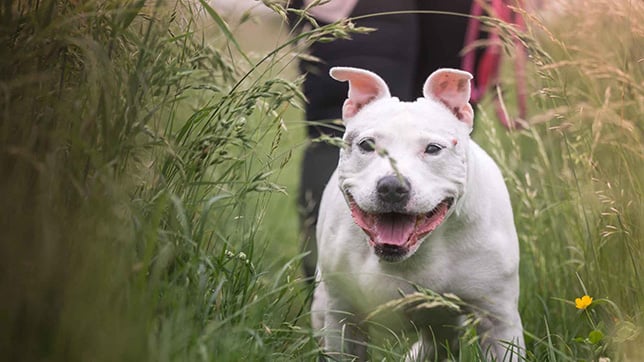
Since they’re such cheerful dogs with ever-wagging tails, it’s easy to see why Staffordshire Bull Terriers are the canine companions of choice for so many families!
Their high levels of intelligence mean that Staffordshire Bull Terriers are often excellent to train. However, it’s important to work on their loose lead walking, to help discourage pulling on the lead, when your Staffordshire Bull Terrier becomes over-excited during their walkies.
A Staffordshire Bull Terrier’s short, smooth hair usually needs to be brushed weekly, to keep their coat shiny and their skin healthy.
Explore our Staffordshire Bull Terrier breed guide for more information about these lively dogs!
Please note: We’ll refer to dogs of the Staffordshire Bull Terrier breed as ‘Staffie’ or ‘Staffies’ throughout this breed guide.
Which health conditions can affect Staffordshire Bull Terriers?
Please remember that while the following health concerns are frequently seen in Staffordshire Bull Terriers, each dog is a unique individual. So, your canine companion isn’t necessarily going to suffer from any of the health conditions commonly experienced by Staffies. But, if you’re considering pet insurance, you could read our guide to insuring your Staffordshire Bull Terrier for more information.
Always speak to your vet if you’re concerned about your dog’s health.
Don’t forget to visit our dog first aid guides to discover the basics of canine first aid.
Skin allergies and infections (Atopy) in Staffordshire Bull Terriers
Atopic dermatitis, also known as atopy or skin allergy in the Staffordshire Bull Terrier, is a common diagnosis in this breed. Dogs with atopy are likely to scratch, chew, and/or lick the parts of their body that are itchy, inflamed or irritated, which could include face, ears, armpits (axillae), tummy (abdomen) and paws.
Vets can diagnose atopic dermatitis by evaluating your Staffordshire Bull Terrier’s medical history and symptoms, alongside performing a thorough assessment of your dog’s skin.
Just like human allergies, such as hayfever, that require ongoing treatment to manage symptoms, canine atopic dermatitis will probably need to be treated throughout your dog’s life, too.
It can take some trial and error to work out which treatments (or combination of treatments) will work best to ease your dog’s symptoms – for example, medication and/or soothing shampoos. Though, thankfully, the majority of atopic dermatitis cases can be managed effectively to make sure your Staffordshire Bull Terrier is able to enjoy life to the full.
Hip dysplasia
Canine hip dysplasia is a genetic condition (something a dog is born with) that impacts their hip joints. For Staffies with hip dysplasia, either one or both of their hip joints are unstable and can cause them to experience pain, swelling, and stiffness – resulting in lameness. Eventually, hip dysplasia can cause Staffies to develop arthritis.
Treatments for canine hip dysplasia include weight management, anti-inflammatory medication, and surgery.
Eye ulcers
An eye ulcer, or ‘corneal ulcer’, is a wound on the front of your Staffordshire Bull Terrier’s eye. Eye ulcers can vary greatly in severity, though they often appear suddenly and might get worse over a short space of time.
Although eye ulcers can have many different causes, ranging from injury to infection, the shape of a dog’s face can increase their risk. For example, eye ulcers are commonly seen in flat-faced breeds, like the Staffordshire Bull Terrier.
Symptoms like a runny eye, holding their eye closed, and cloudiness of the eye could suggest your Staffordshire Bull Terrier is suffering from an eye ulcer.
Along with a physical examination of your Staffordshire Bull Terrier’s eye, a vet may use a green-orange dye, called fluorescein, to check the size and severity of an eye ulcer
To treat a canine eye ulcer, your vet could prescribe eye drops and pain relief, as well as providing support through frequent check-ups, until your Staffordshire Bull Terrier’s eye has healed. If, however, your Staffordshire Bull Terrier has a deep corneal ulcer or their eye fails to heal after a course of treatment, they might need surgery to treat it.
Cataracts in Staffordshire Bull Terriers
Cataracts may occur in the Staffie breed.
Although cataracts in humans are often associated with getting older, that’s not the case for dogs. Your Staffie may inherit cataracts from birth, though they could also develop cataracts at any age as a result of eye inflammation, diabetes, or nutritional issues.
A cataract can lead to blindness over time, so if you notice your Staffie’s eye(s) becoming blue, appearing a different colour inside, or the iris (the coloured part of the human eye, generally brown in the Staffie) and lens becoming less distinct, it’s important to take them to the vet for a check-up.
How much cover do you need?
Our average vet fee claim for a dog was for £1019 in 2025.
Knowing how much your dog could cost is important, so you’re prepared with the right type of policy and we’re here to help.
*This figure shows the average cost of vet fees claimed for dogs, for the top 15 conditions that were submitted to Animal Friends in 2025.

Need insurance for your Staffordshire Bull Terrier?
Dog insurance can help cover the cost of veterinary treatment if your Staffordshire Bull Terrier gets injured or falls ill.
Looking for more dog advice?
Find the information you need as we support you through every step of your journey with your canine companion.
We know pets
Here at Animal Friends Insurance, we're multi-award winning, with a passion to create a better life for every animal.
Since we were founded over 25 years ago, we protect the nation’s pets, while also making a difference to animal welfare and our planet. Thanks to you, we've donated over £10 million to more than 830 animal welfare charities and conservancies, helping to support vulnerable pets and wildlife around the world.
We’re proud to offer pet insurance that helps make a difference to the lives of animals everywhere.
The charitable work undertaken by Animal Friends Insurance is not regulated by the Financial Conduct Authority.