
10th June 2026
Golden Retriever breed guide
A firm favourite for families, competing in dog shows, and working in a wide range of important roles, the Golden Retriever is as talented as they are good-natured!
Read our guide to find out more about the wonderful Golden Retriever breed.
Golden Retriever overview
| Size | Large - 25-34kg |
| Lifespan | 10-12 years |
| Exercise needs | High - 2+ hours daily |
| Grooming needs | High - Daily grooming required |
| Suitable for | Very family friendly due to their gentle and friendly nature. |
| Outdoor space | Needs a large garden and space to be active and stimulated. |
| Common health issues | Hip issues, cancer |
| Personality | Gentle, friendly, sociable |
Common characteristics of the Golden Retriever breed
Please remember that the following characteristics are considered ‘average’ for Golden Retrievers, and since each dog is a unique individual, your Golden Retriever’s characteristics may differ.
How big are Golden Retrievers?
Most Golden Retrievers tend to reach a height of 51-61cm (at the shoulder), with females sometimes slightly shorter than males.
How much do Golden Retrievers weigh?
A Golden Retriever usually weighs approximately 25-34kg.
How long do Golden Retrievers live?
On average, Golden Retrievers have a lifespan of around 10-12 years.
Typical Golden Retriever appearance
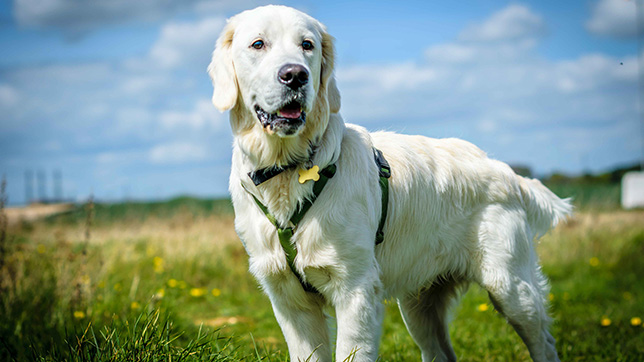
The Golden Retriever is instantly recognisable with that lustrous, golden coat.
With those chiselled features, folded ears, and beautiful brown eyes, it’s almost impossible to resist a Golden Retriever’s requests for extra snacks!
Alongside their ever-cheerful expression, Golden Retrievers have an athletic frame, and comparatively short legs, hidden beneath a medium-to-long, silky coat. They usually have either a flat or wavy topcoat with a dense, water-resistant undercoat. To keep them in tip top condition, and to prevent their hair from matting, Golden Retrievers require daily brushing.
Plus, thanks to all that hair, you’ll need to have a decent vacuum cleaner to hand whenever your Golden Retriever starts moulting!
Golden Retrievers can have a coat in any shade of gold or cream, and some may even have a dusting of white hairs on their chest.
Typical Golden Retriever temperament
As a member of the ‘gundog’ group, Golden Retrievers are highly active dogs who require plenty of exercise and mental stimulation. In fact, it’s recommended that Golden Retrievers enjoy at least an hour or two of exercise every day to stay happy and healthy.
In terms of training, Golden Retrievers are excellent at learning new skills – especially if food is involved! Though be careful not to feed your Golden Retriever too much, because the breed can be prone to obesity.
Since they’re so intelligent, Golden Retrievers can turn their paw to practically any activity you want to embark on together. Whether it’s agility, trick training, or water retrieval games, your Golden Retriever will relish the chance to have fun with you!
The Golden Retriever is also well known for being a kind, gentle dog who adores being part of a family. However, it’s important that your Golden Retriever is socialised from a young age, to make sure they’re confident while out and about on family adventures.
These gorgeous dogs adore water, particularly if that water is muddy! For this reason, if you’re walking near water (e.g. a pond or the sea), it’s worth keeping your Golden Retriever on a lead, unless it’s safe for them to swim.
How much does a Golden Retriever cost?
A Golden Retriever puppy can cost upwards of £1,395. To buy a mature age Golden Retirever can cost around £1000.
Obviously, a Golden Retriever’s price is dependent on whether you are buying a pedigree dog from a reputable breeder, which would cost considerably more.
According to a 2020 study, the Golden Retriever was hailed the 29th most expensive dog breed to own, with a lifetime cost of £17,095. Thats £16,735 less expensive than the top-ranked dog, a Sprollie (crossbreed between a Border Collie and an English Springer Spaniel).
Dog beds, collars and leads into the mix, can take your one-off cost for equipment up when you bring a Golden Retriever home, and that's before they've eaten anything.
How much do Golden Retrievers eat?
As puppies, Golden Retrievers usually eat 200g to 300g cups of dry food a day, split over two meals, whilst older members of this breed require around 300g to 550g of dog food a day, depending on their weight and activity levels
Golden Retriever owners could spend at least £1.76 a day feeding their pets, whilst owners of puppies spend around £2.22.
After one year, puppies should begin to eat adult-sized portions, meaning that over the course of your Golder Retriever’s lifetime, you would spend at least £7,898.95 on pet food alone, with a monthly cost of between £54.85.
How much does it cost to groom a Golden Retriever?
Golden Retrievers most distinctive quality is certainly their illustrious golden coat. However, as it’s so thick, this breed requires regular grooming, with the hair on their legs requiring plenty of attention to avoid tangling. Their topcoat doesn’t require any cutting, just brushing, as any water or mud they attract can be easily cleaned off when dried.
They aren’t the best dogs for families with members who have allergies as they’re heavy shedders.
You should be getting your dog groomed every six – eight weeks, which could cost owners £80 or more. This means owners will have to spend around £520-£693 on pet grooming annually.
Golden Retriever health conditions
It’s not unusual for pedigree breeds to be prone to certain health concerns, and, unfortunately, Golden Retrievers are no exception. Here are a few health conditions commonly seen in the Golden Retriever:
- Obesity.
- Hip dysplasia.
- Elbow dysplasia.
- Eye problems (like cataracts).
- Ichthyosis (the skin on their footpads becomes thick, greasy, and flaky).
However, Golden Retrievers have a low susceptibility to illness, which is a benefit to owners for many reasons:
- They have a lengthy lifespan and as they’re not ill regularly or easily
- They have a better opportunity of surpassing their average lifespan, which is 12 years – however, don’t be surprised if your Golden Retriever lives until they’re 18 years old
Golden Retrievers need anumber of things to maintain good well-being, including worming, flea treatment and neutering.
Neutering is done to eliminate the risk of testicular and breasts cancers, and it’s recommended that Golden Retrievers are treated for worms and fleas quarterly.
Golden Retrievers need to be vaccinated against many illnesses when they’re a puppy. This includes vaccinations for hepatitis, parainfluenza and canine distemper.
For further information about some of the common conditions experienced by Golden Retrievers, please visit our Golden Retriever health problems article.
Remember: Keep an eye out for any health issues your Golden Retriever may develop, and get your canine companion checked by a vet if you have any concerns. If you are considering pet insurance, be sure to read our guide about insuring your Golden Retriever.
Golden Retriever breed history
It’s believed the Golden Retriever first appeared in 19th century Scotland, where a politician known as Lord Tweedmouth set out to develop a golden-coated gundog to retrieve game from water. The first litter of yellow-coated puppies recorded was born to Lord Tweedmouth’s yellow wavy coated retriever and dark-coated tweed water spaniel.
Originally, these golden gundogs were referred to as Guisachan retrievers – named after Lord Tweedmouth’s Guisachan estate. To enhance the working qualities of Guisachan retrievers, Lord Tweedmouth added bloodhounds and Irish setters to his breeding stock.
While the Kennel Club first recognised the ‘yellow or Golden Retriever’ breed in 1913, the Golden Retriever Club was formed in 1920. The formation of this club is what led to the breed’s official name being recognised as the ‘Golden Retriever’.
Today, Golden Retrievers have captured the hearts of pet parents around the world. Yet, the Golden Retriever breed also transforms lives through their work as guide dogs, assistance dogs, and therapy dogs, along with working as life-saving search and rescue dogs.
Fun facts about Golden Retrievers
- Lord Tweedmouth’s Guisachan estate is still used as a location for Golden Retriever shows!
- The addition of several different breeds to the Golden Retriever’s ancestry is thought to have influenced the variety of shades seen in their coat colours today.
- Golden Retrievers are so gentle and have such soft mouths that they’re said to be able to carry an egg in their mouth without cracking the shell.
- Several Golden Retrievers have turned their talents to acting and have appeared in famous films, like Shadow from Homeward Bound!
- Along with being one of the most versatile dogs, the Golden Retriever is considered the fourth most intelligent dog breed in the world.

Need insurance for your Golden Retriever?
Dog insurance can help cover the cost of veterinary treatment if your Golden Retriever gets injured or falls ill.
Looking for more dog advice?
Find the information you need as we support you through every step of your journey with your canine companion.
We know pets
Here at Animal Friends Insurance, we're multi-award winning, with a passion to create a better life for every animal.
Since we were founded over 25 years ago, we protect the nation’s pets, while also making a difference to animal welfare and our planet. Thanks to you, we've donated over £10 million to more than 830 animal welfare charities and conservancies, helping to support vulnerable pets and wildlife around the world.
We’re proud to offer pet insurance that helps make a difference to the lives of animals everywhere.
The charitable work undertaken by Animal Friends Insurance is not regulated by the Financial Conduct Authority.